Your furnace needs a repair, and the technician mentions it might be time for a new one. Now you’re deciding whether to repair or replace your furnace, often with a cold house and a quote in hand. Here’s a straight way to make the call: two quick rules of thumb, the six factors that actually decide it, and the situations where the answer is clear.
The Quick Answer
Repair when the furnace is under about 12 to 15 years old, the repair is modest, and it’s the first real problem in a while. Replace when it’s 15 or more years old, the repair is expensive, problems keep coming back, or there’s a safety issue like a cracked heat exchanger.
Most decisions fall somewhere in between. That’s where the rules and factors below help.
Two Rules of Thumb for Furnace Repair or Replace
The $5,000 Rule
Multiply the repair cost by your furnace’s age in years. If the answer is over about $5,000, replacement usually makes more sense.
Example: a $400 repair on a 16-year-old furnace gives $6,400. That points toward replacing. The same repair on an 8-year-old furnace gives $3,200, which points toward repairing.
The 50% Rule
If one repair costs more than half the price of a comparable new furnace, replacing is usually the better use of that money.
These are starting points, not verdicts. A good technician will help you weigh the rest.
6 Factors That Decide It
1. Age
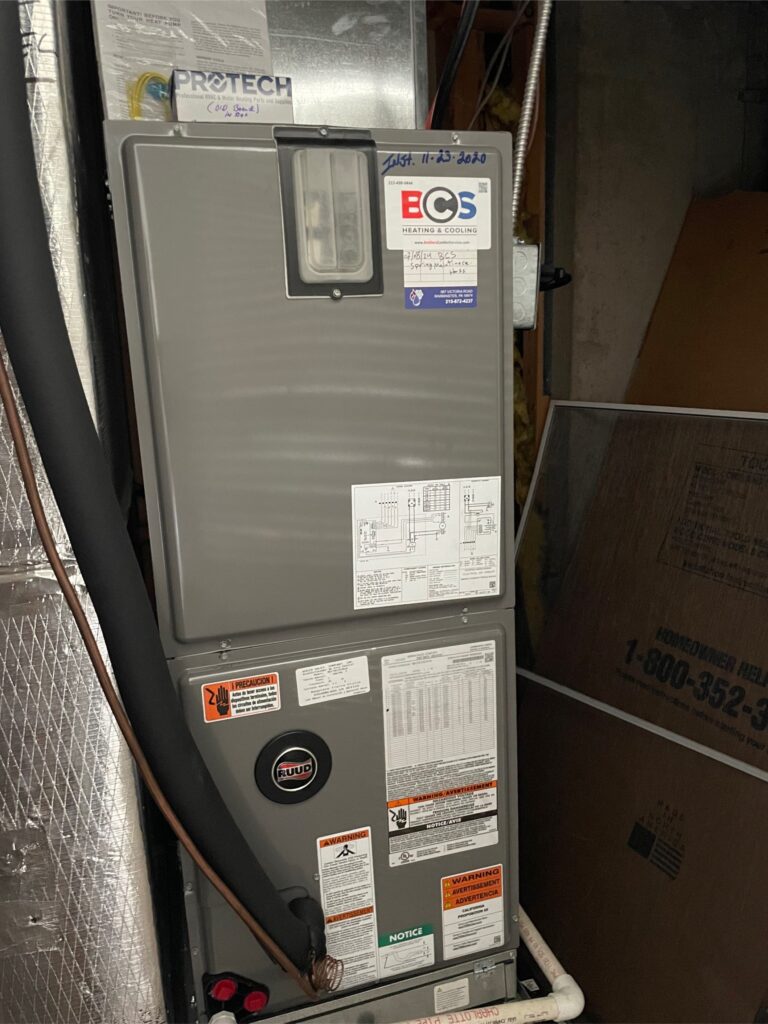
Many gas furnaces last roughly 15 to 20 years with good maintenance. Past 15, each repair buys less time. If you don’t know the age, the manufacture date is usually on the label inside the panel.
2. How Often It’s Needed Repairs
One repair in several years is normal. Several service calls in the last couple of winters is a pattern, and the next breakdown often comes on the coldest night.
3. Safety
A cracked heat exchanger can let combustion gases, including carbon monoxide, into your home. That usually means replacement regardless of age. So does any repeated safety shutdown your technician can’t fully resolve.
4. Efficiency and Heating Bills
Furnace efficiency is measured as AFUE, the share of fuel that becomes heat in your home. Many older furnaces are around 80% AFUE or lower. ENERGY STAR certified furnaces are much higher, so a new one uses noticeably less gas for the same heat.
5. Comfort
Cold rooms, dry air, noise and constant cycling aren’t always fixed by a repair. A properly sized new system can solve problems an old one never will.
6. Your Plans
If you’re selling in a year or two, a sensible repair may be enough. If you’re staying for the long haul, a new system pays you back over more winters.
Repair vs. Replace at a Glance
| Repair usually makes sense when | Replace usually makes sense when |
|---|---|
| The furnace is under about 12 to 15 years old | The furnace is 15 or more years old |
| It’s the first significant repair in years | You’ve had several repairs recently |
| The repair is a small share of a new system’s cost | The repair passes the $5,000 or 50% rule |
| There’s no safety issue | There’s a cracked heat exchanger or other safety issue |
| Your bills and comfort are fine | Bills are rising and some rooms never warm up |
| You’re moving soon | You’re staying for years |
If You Replace, You Have Options
Replacing doesn’t have to mean the same furnace again:
- High-efficiency gas furnace: lower gas use for the same heat.
- Cold-climate heat pump: heating and cooling in one system, built for Pennsylvania winters.
- Dual-fuel: a heat pump for most of the year, with a gas furnace for the coldest days.
The federal heat pump tax credit ended in 2025, but utility rebates and financing are still available. See what heat pump rebates are still available in Montgomery County.
If you’re leaning toward replacing, plan it before your furnace fails. Here’s why replacing before winter beats an emergency replacement.
What to Ask Your Technician
- How old is my furnace, and what condition is it in overall?
- Is this repair likely to be the last one for a while, or the first of several?
- Is there any safety concern?
- What would a replacement involve for my home, and what are my options?
- Can I get the repair cost and replacement estimate in writing?
A trustworthy contractor will answer plainly and won’t push you to replace a furnace that has good years left.
Get an Honest Answer From a Local Team
Brothers Comfort Services has repaired and replaced furnaces across Montgomery County for more than 25 years. We’ll tell you straight whether a repair makes sense, and if replacement is the better call, we’ll give you a free estimate on options from Carrier and Mitsubishi.
Call (215) 498-0444 or request your free estimate. If your heat is out right now, see what to check when your furnace is not working, or call us 24/7.
Frequently Asked Questions
Should I repair or replace a 15-year-old furnace?
It depends on the repair and the furnace’s condition. A small repair on a well-maintained 15-year-old furnace can make sense. An expensive repair, repeated breakdowns or a safety issue usually point toward replacing.
What is the $5,000 rule for furnaces?
Multiply the repair cost by the furnace’s age in years. If the result is over about $5,000, replacement is usually the better value. It’s a rule of thumb, not a final answer.
Is a cracked heat exchanger worth repairing?
Usually not. A cracked heat exchanger can leak carbon monoxide, and fixing it often costs close to a new furnace. Most homeowners replace the furnace.
How long does a furnace last?
Many gas furnaces last roughly 15 to 20 years with regular maintenance. Condition and repair history matter as much as age.
Can I replace my furnace with a heat pump?
Yes. A cold-climate heat pump can replace both your furnace and AC, or work alongside a gas furnace in a dual-fuel system.